




Image Credit: Depositphotos
Gap analyses are relatively common for businesses. They are usually done regarding financials and operations, identifying areas for income improvement and cost containment or for needed process improvements.
But that same attention is not always given to gap analysis for teams. Neglecting this analysis can result in weak culture, missed goals, and low productivity.
The good news is there are now tools to accurately identify these gaps with measurable metrics. Where you can quantify the gap, you can then fill it in and measure true progress. Stronger teams help tighten the gaps in financials and operations as well.
Investing in the development of a strong team pays off all the way to the bottom line.
One of those tools is the Maxwell DISC assessment. This allows you to identify the strengths and potential weaknesses on your current team. And the Group/Team report helps identify gaps to be filled. It also identifies the team members best suited for various types of work, thus increasing efficiency.
The Gap
High Rate of Burnout, Frustration, and Conflict
It was a very successful company, with an iconic brand and a loyal fan base. But the team behind the scenes suffered from frustration and burnout. Turnover was high. The projects were many; the timelines were short, and team did not have capacity to do all that was expected of them.
The Problem
They had it all – great ideas, quality products, dedicated team members, loyal fans, and driven leaders. So, what was the problem?
It turns out it was a matter of ratio. The ratio of D/I-wired leaders, driven by results and powered by ideas, was higher than the small team could support. As the leaders individually relied on the same team, the team became overwhelmed. The missed deadlines and lack of results, in turn, frustrated the leaders, all resulting in a stressful work environment that began to eat away at the foundations of the company
The Solution
Correct the ratio. Manage the ratio of D-wired leaders to the number of team members who carry out the details. In a company setting, this is often a 1 to 7 or 10 ratio. This gives the team one clear leader, and it gives the D/I-wired leader enough support to carry out the number of initiatives they desire to have moving forward at once.
—-
The Gap
Income Does Not Exceed Expense
Financial issues boil down to just two sides of the equation: Income and Expense. But what affects each of these sides requires a good gap analysis. And here is the part many miss: business, at its core, exists to serve people. Externally, customers and clients provide income. And internal management of expenses helps maintain the health of the company.
The Problem
The economy was tight. The cost of inputs was high. And demand was lower, as clients hesitated to pay for the added costs of production. Most companies tightened production, deciding to manage expenses and tap into some of their reserves until the stormy economy recovered.
Except one.
They determined that, despite the exponential cost of production, they would forge ahead. They reasoned that, while the competitors tightened supply, they would be the ones to carry a surplus. The visionary leadership was certain that, like the move line, if they built it, the customers would come.
But the customers didn’t come.
This left them with millions of dollars’ worth of products that no one would buy. It was the final move that took the company down.
The problem was that they pushed forward with vision but failed to count the cost and analyze true projections.
The Solution
The company demise could have been avoided if the visionary leader had listened to the strong analysts on his team. They knew the numbers just would not work. As much as they wanted to outpace the competition, they could see that their competitors were right.
The solution for a very visionary, growth-focused leader is to have a very strong operations team. This creates balance.
—-
The Gap
Stagnation
Companies must retain the ability to change and pivot, strategically. To “do things as they have always been done,” while the world changes dramatically, nails a company to the point of stagnation.
The Problem
Everything was falling flat. Sales of the programs that had sold so well in the last two decades now fell flat with a resounding thud. The industry had changed. The business had not. In a world of advancing technology, they had become the proverbial dinosaur.
The problem was that they had failed to innovate.
The Solution
This is where the ideators and problem solvers shine. The I-wired leaders bring new and innovative ideas to the forefront, while the C-wired solutions experts create the technology and quality to make it happen. The S-wired team members establish systems to deliver the new program efficiently.
Where a company has flat-lined, a D-wired leader can drive it forward into new territory; while the I-, S-, and C-wired team members create the pivot that is needed.
—-
The Common Thread
These scenarios have one thing in common: teamwork. Creating a team that reflects strengths across all four channels of DISC creates drive, innovation, efficiency, and quality solutions. A strong team can fill the gap and bring solutions to the problems companies face.
Who do you need on your team?
Consider your team, both personally and professionally. What gaps do you need to fill? You can stare at the gap, while it all goes away, or you can identify the problem and, with your team, create a solution.
Be sure to check out the tools below to help identify the gaps and find the solutions you need!
For valuable resources on Leadership Strengths and Tools, click here.
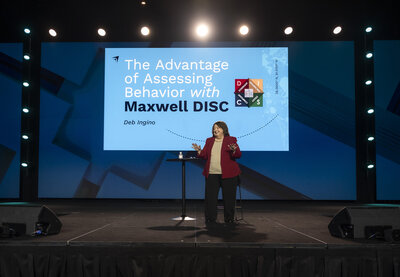
Deb Ingino is a highly sought-after executive coach, mentor, consultant, and speaker worldwide. Deb is well versed in business operations and in the importance of asking key questions most business leaders won’t ask themselves. She brings deep experience in leadership development, strategy, high performance team building and effective communication. She has a passion for leading people to discover and maximize their strengths as well as those of fellow team members, while offering advanced strategies to achieve high performance. Deb is the perfect fit if you’re ready to take your leadership and impact to the next level!








+ view comments . . .